Tuesday, July 11, 2006

"Dark Matter" in the common vernacular?

Saw in an interesting article in Time magazine about how much of who we are is determined by our siblings. What struck me though, was that in the introduction, when they were talking about scientists looking at the influence of both genes and parents, there was some missing effect akin to "dark matter":


The fact is once investigators had strip-mined all the data from those theories, they still came away with as many questions as answers. Somewhere, there was a sort of temperamental dark matter exerting an invisible gravitational pull of its own. More and more, scientists are concluding that this unexplained force is our siblings.


I think that it's great that such things can now be used for nonspecialists. There's also an article on some recently unsealed letters of Einstein which I'll have to read.

Saturday, July 08, 2006

Soda geyser

You might have seen such soda geysers before, but here's a pretty neat video of a couple guys in labcoats and quite a number of 2 liter soda bottles. Seen via Scientific American's blog here, which has a nice explanation for the effect.

Flipping Tennis Rackets

When I teach non-science majors, I worry more about getting across to them the wonder that is science, rather than lots of details or explanations. I recently taught a class with mostly art, film, and literature majors, and I think I did a decent job of communicating to them that I do science/physics for pretty much the same reasons they do what they do...it's wonderful, amazing, interesting, and beautiful. I think many are really surprised by this.

In any case, one of the really cool things showed up when I was a freshman in college. For some reason, most of my physics classes were at 8am. I didn't have any problem waking up that early, I just couldn't stay up! Fortunately, high school had taught me to sleep with my eyes open.

So I'm half asleep, and my internal clock, detecting the end is near, is slowly ramping up my consciousness, and then I start hearing what the whole lecture has been about....rotational dynamics and instability. The board is filled with equations and steps, and I realize we've explained something that's been an oddity to me for years.

Tennis players are always flipping their tennis rackets. When the other person serves, I spin my racket in my hand (along the axis through the handle). If I have to wait for something, I may spin the racket edge on, so you don't see the face. But if I'm really killing time, I point the racket out like I'm holding a tray, and then I flick it in the air. Almost all of the time, the racket then does a spin, like a high diver doing a twist. If I try real hard, I can usually flip it without the twist but it's hard. Why? Well, using just some chalk on a board, we had explained why a flip about (what turns out to be) the intermediate axis is unstable!

A more complete explanation of this effect can be found at Physics Central, but nicer videos (but with a board, not a tennis racket) is up here (the third axis is the one with the instability).

To a non-physicist this result may not elicit much excitement, and may even seem trivial. But for me, ...well, it's hard to explain, but it's powerful. It boils down to power. Physicists are so powerful, we have control. Like the Connecticut Yankee in King Arthur's Court, we have power because we have knowledge and understanding. It's a bit like a kid with one of those chemistry sets, or the adult who dreams of having all those power tools with lasers.

Friday, July 07, 2006

Superman in Extra Dimensions


  • Slashdot links to an article on the physics of Superman. I didn't know he travels at close to the speed of light, but if he does, the article points out, then the world will age quite a bit while he's flying around. For more on Superman, Phil Plait has a review up of the latest movie Superman Returns , but I've not read it because he's got spoilers in there.


  • The CHE has an article up (subscription reqd) which answers the question, "how much time do I waste?"...for many, the answer is already known:
    A survey of 6,000 university researchers found that scientists spend 42 percent of their research time filling out forms and in meetings. With those hard numbers to back his case, the professor who designed the survey hopes to persuade the federal government to amend its grant-making system.


  • Woit's latest has a quote about extra dimensions from Lawrence Krauss (of the physics of star trek fame, among other work):

    Many of the papers in particle physics over the last five to seven years have been involved with the idea of extra dimensions of one sort or another. And while it~Rs a fascinating idea, but I have to say, it's looking to me like it~Rs not yet leading anywhere. The experimental evidence against it is combining with what I see as a theoretical diffusion, a breaking off into lots of parts. That's happened with string theory. I can see it happening with extra-dimensional arguments. We're seeing that the developments from this idea which has captured the imaginations of many physicists, hasn't been compelling.

    I confess that I am one who does find it pretty fascinating, and in particular I've long been an admirer of the work of Eöt-Wash group looking for evidence of these extra dimensions. Their work is good science and they give good talks. There's also this today from the New Scientist describing a proposed experiment to do a similar measurement as the Eöt-Wash group, just to do it out in space! Good luck getting that kind of precision and getting it launched.


Update: Backreaction has a short tutorial on extra dimensions posted today.

Thursday, July 06, 2006

Various (but not sundry)


  • Uncertain Principles talks about his work in the machine shop. I'd like to hear more. I imagine that many of the people reading these physics blogs are pretty current on the latest theories, but do they know what a machine shop is like? It's wicked cool, as my Massachusetts friends would say. Where are the machinists' blogs? I'd like to hear stories about what it's like to be in the control room of one of the big physics experiments.

  • This isn't physics, but I'm happy to report that Delay's name has to stay on the ballot for the upcoming election in Texas. What happened to the days when people simply disagreed about controversial issues, instead of the war we have now?

  • There's some discussion about possible changes to the introductory
    physics curriculum...started by Gordon Watts and continued at Uncertain Principles. My $0.02 is that it may all be for naught (a great word). "Six Easy Pieces" doesn't work, the material has to be covered even if covered in high school, and there's no good solution. Well, having a good teacher helps.

  • Having linked to a certain blog twice in this post, a good name for a group blog occurs to me..."Uncertain Principals"

  • What's going on at Cosmic Variance? First there was that strangeness with Clifford and now he's at a Monastery? And Sean goes to some strange, fancy-schmancy trip (seems kind of a like Hollywood's answer to the Jason group).
    And now Sean is discussing poker again (I've got the answer to his little question easily with no help from the comments!). Anyway, not sure from where Mark will turn up...maybe from a kibbutz in Israel?

    I propose we get a virtual game of poker among us physicists. Does Party Poker allow people to get their own table?

  • Finally, Big Brother gets going tonight. CBS sticks a bunch of meatheads together in a house with no TV or cell phones and boredom commences. Eventually, people start running around naked and screaming at each other, the perfect recipe for unscripted TV. But, and here's the rub....wait for it.....(and give me the royalties I'm due):

    What if some network did this with physicists and mathematicians?


Wednesday, July 05, 2006

Gender and Sexuality

A couple thoughts about gender and sexuality:

  • Finally got around to reeding my Seed magazine, and found an interesting article about homosexuality in the animal world. Well worth a read, and then go read Pharyingula for some criticism (and for some positive things).

    I liked this quote of Phryingula:
    Many heterosexual couples elect not to have children, and many homosexuals elect to have them. This shouldn't be a surprise; all it takes to start a baby is a few pokes and a spurt, and it really doesn't take much effort to overcome an inclination for such a brief event. We are sex-obsessed animals, so redirecting an ejaculation to a particular orifice isn't that astonishing.


    As any good article will do, it got me thinking. What about doing some cellular automata model and seeing what happens? Probably been done before, I'm guessing. But Pharyngula also says:
    I think Roughgarden makes a good case that this has considerable utility in social groups, and she's done some modeling that shows that this is, theoretically, a valid path to stable communities.

    I wonder what type of modeling was done.

  • I saw a bumper sticker today: REAL WOMEN DRIVE TRUCKS. In how many ways is this offensive? It's bad enough that so many men feel defined by their vehicles. Now women? I suppose when women emulate all things bad that are male, perhaps we should celebrate some horrible form of equality. But more than that, women are now going to beat on other women for what they drive? Of course, the cosmetics industry is as big as it is precisely because women can be so harsh, but I still find it offensive. Perhaps not as offensive as seeing so-called "nuts for trucks."


Tuesday, July 04, 2006

James Simons

A nice story about the very famous (in these circles, see relevant posts at NEW) mathematician/physicist James Simons:


"It was radical that it was a hedge fund, but not radical that he wanted more in this world than being a math professor," Kra said.


And for a discussion of the disparity of wealth occasioned by hedge funds, see today's post at Steve Hsu's blog.

Refereeing

One of the duties of a physicist is to review papers submitted for publication. You can call it "peer review" as Andrew Jaffe does in this post. But I prefer the term "referee" because often it boils down to it...I'm often sent already reviewed papers in which the authors are engaged in a heated argument with the referee(s). The Editors in these cases often send all the correspondence to a new referee, who has to referee all the arguments and reach some conclusion.

Anyway, I've got more I want to say about the referee process, and maybe tell a few, but I'll save it for later. But I wanted to address something Jaffe says in the post linked above:


It’s a safe bet that most of us think that our papers are generally not improved in the process, but in the usual self-congratlulatory way, most of us probably think that we’re in the minority of good referees who actually make useful suggestions, or catch egregious errors. We can’t be right about both, not most of us anyway.


I do think that many of the changes suggested/mandated by a referee for my papers have, in fact, improved my papers. However, those changes have been fairly few in number. The problem, as I see it, is that a number of authors seem to do some research, assemble some text and graphs and submit. They then rely on the referees and the revision process to attain a better paper. I think that's an abuse of the system.

Finally, for more discussion on refereeing and such see the discussions linked to in the comments of Andrew's post.

NYT: New physics coming

The NYT has a nice article (reg. required) by Overbye about hopes for new physics at the LHC.

With the LHC coming soon, with LIGO's sensitivity increasing rapidly, with all the neutrino labs, with searches for evidence of extra dimensions, with all the precision cosmology, there really is a lot to get excited about. I wonder if we're set to go through anything similar to the revolutions that occurred at the beginning of the 20th century (relativity, quantum).

Monday, July 03, 2006

Cool Bed


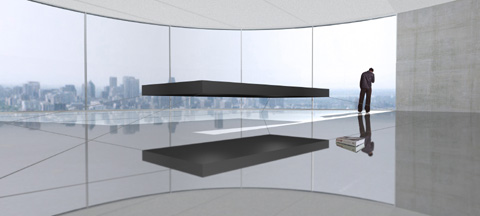
Gizmodo has another cool gadget, a levitating bed. For those who know such a simple levitating system should be very unstable, you needn't worry as they've secured it laterally to the walls. For those that don't, you can read a bit more at the Wikipedia.

The short explanation starts with the idea of a magnet floating above another one, say. The gravitational and magnetic forces have the same magnitude and cancel (as can be measured by observing zero acceleration...my students always think the magnetic force must be greater than the gravitational, but then the magnet would be zooming off into space). Anyway, say this magnet is perfectly balanced laterally. Fine, but you can see it's unstable by considering any small deviation from perfectly balanced. Say a slight breeze pushes it left just a bit. Does it come back to center? No, because now there's even more of the bottom magnet to the right pushing the levitating magnet to the left. So instead of coming back, it just gets pushed off further left. Hence, it is unstable.

Google

I find all things Google pretty cool. I liked reading about Steve Hsu's trip there (and also. Well, the NYT has another article on Google's inventiveness both with respect to the possibility that they're designing their own chips and with respect to software. I liked this quote


Mr. Arnold, the consultant, said these tools created a significant cost advantage. "If you talk to guys who work in massively parallel computing operations, as much as 30 percent of their coding time is spent trying to figure out how to get the thing to run," he said. Google "has figured out how they can reduce a lot of the hassle and work of creating parallel applications."

Mr. Gates acknowledged that MapReduce was a significant technology, but he asserted that Microsoft was building its own parallel processing software, opening another front in the technological war between the two companies.


Make Bill Gates sound...like an also ran, I guess is the way to put it.

Update: Slate has a piece today predicting a Google PC:


But the real deal-breaker is trust: Are you going to let someone else handle all your data? If you use a Google-served computing environment, everything you upload, download, or type potentially passes through Google's computers. I'll be the first to sign up, but that's my blind faith in statistics. If there's a privacy breach at Google, I figure I'll be about 10 millionth in line to get hurt.


I pretty much concur, and plan on using Google's new spreadsheets program to do my grades so I have easy access from home and the office.

Saturday, July 01, 2006

The Brompton Folding Bike

Just got the latest issue of Consumer Reports which reviews folding bikes (online subscription required), and says of the Brompton (Clifford's favorite of Cosmic Variance, follow the link for pictures):


If you plan to ride mostly on flat terrain, and must pack up the bike often, consider the Brompton. It’s quick, folds easily to a compact size, and is the lightest bike in the Ratings. When folded, it’s the only tested bike whose chain is on the inside, so you’re unlikely to get grease on your pants.

Friday, June 30, 2006

Promising site

Continuing in the "kids and science" theme, I happened to see the web site
howtoons.com on CNN this morning at the gym. In their own words:


Howtoons are cartoons showing kids of all ages "How To" build things. Each illustrated episode is a stand-alone fun adventure accessible to all. Our Howtoons are designed to encourage children to be active participants in discovering the world through Play-that-Matters -- fun, creative, and inventive -- and to rely a lot less on mass-consumable entertainment.

Much like MIT has OpenCourseWare distributing curricular materials for college students worldwide, our Howtoons are OpenKidsWare, with practical build-it projects letting kids learn-by-doing, MIT-style!


So far not a lot of videos, but this morning they only 5 and now they're up to 7. Extrapolating, they should have 30 by the time you click through.

Thursday, June 29, 2006

Cool lasers

Over at Uncertain Principles he's got a couple posts about lasers and getting them to do what you want. As I've mentioned before, I think posts such as these are great examples of what physics blogging is about.

Of course, he calls it "Fun With ... Lasers" and I suppose if you go read it and think it's fun, you are (or are destined to be) an experimental physicist. If you think "cool" then you're probably theoretical. And if you think, "I wonder if I could use that to make such-and-such" you're probably an engineer type. I'm tempted to continue this train of thought, but I'm sure I'd start offending people pretty soon.

Keep Asking Questions

In addition to worries about sex, drugs, alcohol, strangers, and obesity, parents might reasonably hope to keep their kids alive with wonder in the face of an academic system which tries to pound it out of them. So in light of this, I thought I'd mention a question one of my nieces staying with us this week asked at breakfast:


Why, when I move this way while looking in my cereal bowl, do I see myself move the other way?


I'm paraphrasing (she's only 5.5 years old), and it took me a bit to understand what she was asking. She was eating cereal in a reflective, metal bowl and looking at her reflection on the inside (concave) part. When she moved left, her reflection moved right.

So she had observed this (kids seem infatuated with reflections), fine. But for her to ask this question, she had to know that in a flat mirror, the reflection follows you. I'm not sure how impressed to be, but I am pretty impressed.

I had a tough time explaining it without math, and I don't think she really understands the answer. I just hope she keeps asking questions.

Epilogue: I pulled out a flashlight to try and explain a bit...the kids love playing with it so it might make for a good gift.

Wednesday, June 28, 2006

Business Travel with Aliens because of Global Warming

I saw mention of this USA Today article about the stress on families from frequent business travel. Reminds me of meeting a well-known cosmologist who went on and on about all his upcoming travel. I was going to say something like, "Oh, you must not have any kids." Some sense told me to hold back though, afterall there are lots of ways that could come off badly...maybe he had had trouble having kids, maybe he was gay, etc. Anyway, I later googled him, and was quite thankful I had held back. Of all the ways I could see that comment as obnoxious, I missed the most obvious...he has kids! (In other words, I would have been saying he was an absentee father who cared nothing for his family).

Slashdot has a post about distributed computing and SETI, seemingly saying that the SETI search is a waste of time.

Finally, I saw this last night on CNN saying that Gore got the science right in his movie An Inconvenient Truth. For a contrasting opinion, you might follow Lubos' link.

Do not waste time!

Since I like to think I'm helping young physicists out there, I'll frame this post as advice. Here are some things you definitely should try to avoid so that you actually get some work done:

  • googling old class mates or yourself
  • browsing the wikipedia
  • scanning html access logs or sitemeter for your blog
  • checking your latest cite summary at Spires
  • keeping up with the rapid fire linking of Instapundit
  • browsing FatWallet
  • reading LQG papers (if Lubos-aligned) or String papers (if Woit aligned)
  • checking the rumor mills ( astro or theory) or the jobs sites (e.g. APS)
  • Worst time killer of all: writing to a blog!

Tuesday, June 27, 2006

Two Stephens

The Colbert Report made some fun of Stephen Hawking last week and it's up over at YouTube. Not hilarious, but it's nice to see some theoretical physics in the mainstream. The Colbert Report must have some physicist(s) on staff because they actually have a fair amount of physics creep into the show in an intelligent way. Maybe they're hiring?

A few months back, Colbert talked about how, if we really wanted to attract kids to careers in science, that instead of the law not applying to celebrities and athletes (have you heard the latest about Limbaugh?), we should allow scientists to do as they please. Doesn't sound funny the way I rehash it, but it was.

Monday, June 26, 2006

Strominger's Talk

After Chad posted the link to the online talks from Strings 06, I took a look at Strominger's* opening talk (looks like he's got a more technical one further down), and thought I'd point that one out in particular. It's nice and fairly easily understood by someone with a basic idea of the state of modern physics.

Two things I also wanted to mention:

  • His talk is of the "hand drawn" type much preferred by some in the community. Not sure if there's as much consensus here as in global warming! The lesson isn't that physicists should hand draw their slides, nor that they should use presentation software. Instead, you should make a good and visible presentation.
  • I liked the slide "Contradiction leads to progress." Besides looking nice, I think it's important to get this idea across to the general public.


*Update: As pointed out in the comments, it's a pretty big file. I don't notice these things much since everything just downloads in the background.

Update 2: A couple other notes now that I've had time to look through some of the other talks. Dijkgraaf has a summary talk posted which starts out a bit funny (and a bit un-PC as well). While he's talking about how this is a remarkable time for many fields, he mentions the Ricci Flow work under the slide title "In the meantime in mathematics"...I mention this in support of my argument with Lubos (see the comments of this post). Finally, he finishes by mentioning that Lubos is locked behind the Great Wall (well "firewall") but that Woit is not.

Google Hack

According to the CHE, some school district is claiming that Google's web scanning robots hacked their systems to expose student information:


Judith Ray, Catawba’s chief technology officer, told the Winston-Salem Journal that one of Google’s Web-scanning robots hacked into a secure server and posted the personal information online.


I'm pretty confident in Google's claim that the charge is total "hogwash." It's easy enough to check the logs of web server and see what these search engines are doing. There's also the robots.txt file which they all seem to obey (the file specifies what not to search).

I have some colleagues, though, who found a draft of an as-yet unpublished paper some competitors were working on through Google. Apparently these competitors were either unaware the paper was in a directory being served by a web server or otherwise thought search engines wouldn't find it. No hacking involved though.